
SellCell Key Findings:
- Half of children between ages 5 to 14 have a mobile phone
- 20% of kids under the age of 5 have a phone
- 811 million children under 14 have a phone
How many children in the world have their own mobile phone? Smartphone ownership by kids varies by age and also by where they live in the world. This article will offer information on how many children have smartphones and what their ages are.
- You can find out how many children have phones, by age globally.
- The data will show how many children have a phone across key countries.
We live in a digital age and smartphones give us access to family, friends, music and even schoolwork. The wide popularity of social media apps, such as TikTok and SnapChat has increased the appeal and demand of smartphone ownership amongst younger people. With peer pressure to get phones earlier and earlier this article will determine how many kids have phones and what the best age is for them to have one.
How Many Kids Have a Mobile Phone Globally and What Age Did They Get It?
Data for 2025 shows there are 1.36 billion kids between ages 5 and 14 in the world, and about 644 million kids under 5. Since not all countries look into such data, the figures below are based on population data and we have chosen the UK’s statistics as a base for the percentage applied to the two age groups. The UK has one of the most complete data sets in terms of age groups, so we’re applying UK trends to global population data. Country totals in the table are estimated by applying UK-based ownership percentages to United Nations World Population Prospects (2025) child population data, rather than taken from direct national ownership surveys. A brief look at data sets from other countries indicates similar trends to what we see in the UK.
| AGES 5-14 | UNDER 5’S | |
|---|---|---|
| Globally | 1,364,750,145 | 643,562,102 |
| @50% | @20% | |
| 682,375,073 | 128,712,420 | |
| China | 170,661,904 | 47,520,142 |
| @50% | @20% | |
| 85,330,952 | 9,504,028 | |
| India | 241,085,430 | 113,100,740 |
| @50% | @20% | |
| 120,542,715 | 22,620,148 | |
| United States | 40,806,305 | 18,574,530 |
| @50% | @20% | |
| 20,403,153 | 3,714,906 | |
| Indonesia | 47,182,473 | 22,097,071 |
| @50% | @20% | |
| 23,591,237 | 4,419,414 | |
| Brazil | 28,377,139 | 12,879,997 |
| @50% | @20% | |
| 14,188,570 | 2,575,999 | |
| Russia | 17,874,937 | 6,644,198 |
| @50% | @20% | |
| 8,937,469 | 1,328,840 | |
| Japan | 9,914,899 | 3,919,960 |
| @50% | @20% | |
| 4,957,450 | 783,992 | |
| Mexico | 21,664,998 | 10,122,411 |
| @50% | @20% | |
| 10,832,499 | 2,024,482 | |
| United Kingdom | 8,266,817 | 3,532,409 |
| @50% | @20% | |
| 4,133,409 | 706,482 | |
| Turkey | 13,082,237 | 5,351,786 |
| @50% | @20% | |
| 6,541,119 | 1,070,357 | |
| Philippines | 22,741,286 | 8,953,366 |
| @50% | @20% | |
| 11,370,643 | 1,790,673 | |
| Germany | 7,948,498 | 3,726,084 |
| @50% | @20% | |
| 3,974,249 | 745,217 | |
| France | 7,489,352 | 3,324,658 |
| @50% | @20% | |
| 3,744,676 | 664,932 | |
| Vietnam | 16,321,142 | 6,900,236 |
| @50% | @20% | |
| 8,160,571 | 1,380,047 | |
| Italy | 4,896,058 | 1,998,720 |
| @50% | @20% | |
| 2,448,029 | 399,744 | |
| South Korea | 4,024,209 | 1,248,137 |
| @50% | @20% | |
| 2,012,105 | 249,627 | |
| Thailand | 7,352,725 | 2,970,697 |
| @50% | @20% | |
| 3,676,363 | 594,139 | |
In total, just over 811 million children under 14 have a smartphone, which is an impressive number. By the time they turn 18, almost all children have one of these devices in their pockets.
- Kids Under 5 – 128,712,420 out of 643,562,102
- Kids Ages 5-14 – 682,375,073 out of 1,364,750,145
How Many Kids Have a Mobile Phone in the USA?
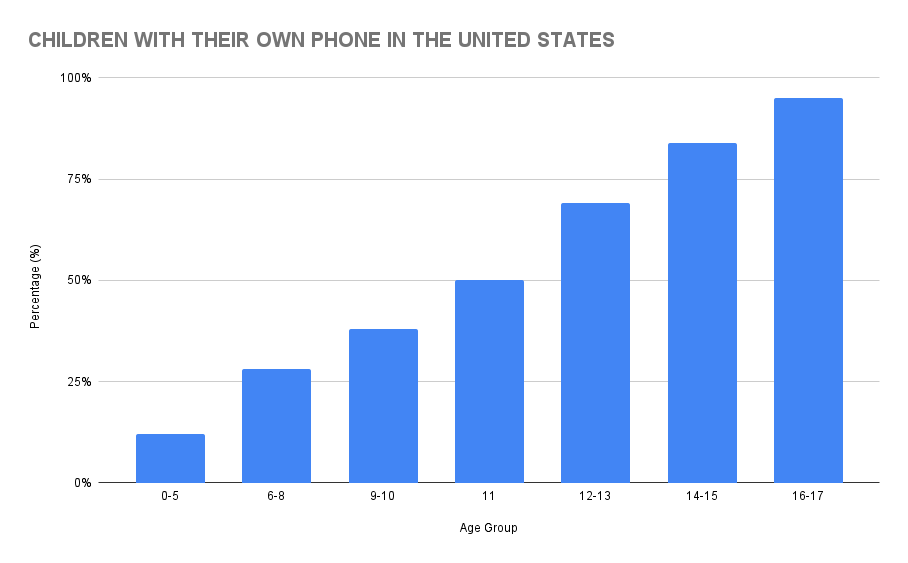
| CHILDREN WITH THEIR OWN PHONE IN THE UNITED STATES (2025), BY AGE GROUP | |
|---|---|
| Age Group | % with own phone |
| 0-5 | ~10–15% |
| 6-8 | ~28% |
| 9-10 | ~38% |
| 11 | ~50% |
| 12-13 | ~69% |
| 14-15 | ~84% |
| 16-17 | ~95% |
| 12-17 overall | ~83% |
- Somewhere between 10 and 15 percent of 0-5 year olds have access to or use smartphones in the United States.
- Ownership increases to 28-38% between age 6 and 10.
- As children progress to high school between the age of 11 and 13 we see a significant spike with 50-69% of kids who own their phone in the United States.
- In the United States age 14-17 sees almost universal ownership with 84-95% of children in this age group having their own phone.
- Over 3.7 million kids under 5 and over 20.4 million kids between 5 and 14 years old have a smartphone in the United States.
- Over 42% of kids spend over 30 hours on their phones every week, this SellCell survey shows.
- Children in the United States (and other countries) will most often start interacting with phones before they own one. Many will often start at a very young age, sometimes before the age of 5. 11
How Many Kids Have a Mobile Phone in the UK?
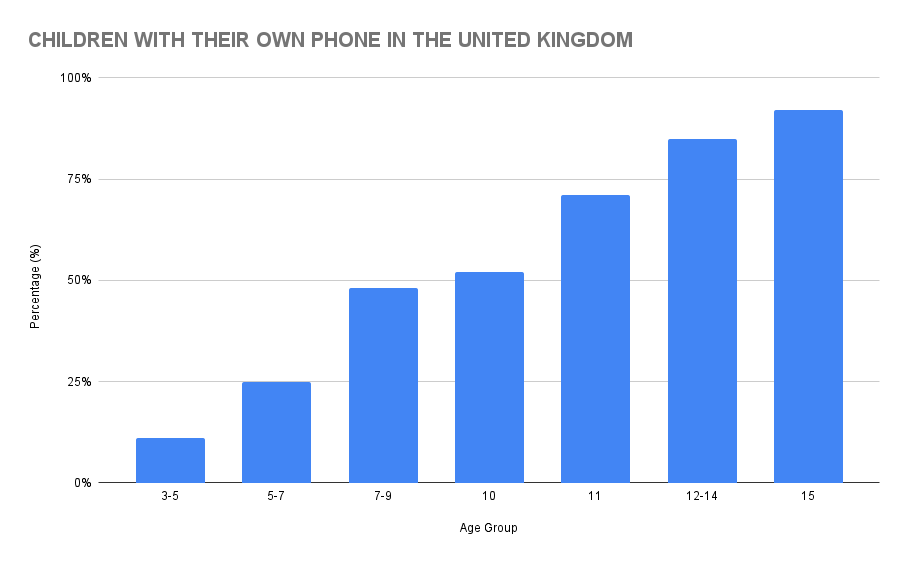
| CHILDREN WITH THEIR OWN PHONE IN THE UNITED KINGDOM (2025), BY AGE GROUP | |
|---|---|
| Age Group | % with own phone |
| 3-5 | ~11% |
| 5-7 | ~25% |
| 7-9 | ~48% |
| 10 | ~52% |
| 11 | 71% |
| 12-14 | ~85% |
| 15 | ~92% |
| 16-17 | ~95% |
| 10-15 overall | ~80% |
- In the UK very few children; Just 11% aged 3-5 have access to or use a smartphone.
- Ownership rises sharply with 48-52% of children aged between 7 and 10 having their own phone.
- Between the age of 11 and 14, 71-85% of kids own a smartphone and between the age of 15 and 17, 92-95% own a smartphone in the UK.
- Roughly 706 thousand kids below the age of 5 have a phone in the United Kingdom, with the number spiking to 4.1 million for the 5-14 age bracket.
- On average, children spend about three hours and 20 minutes each day on their phones. 4
- In the UK campaigns to delay smartphone ownership and proposals to limit children’s access to social media are gaining traction. 12
How Many Kids Have a Mobile Phone in China?
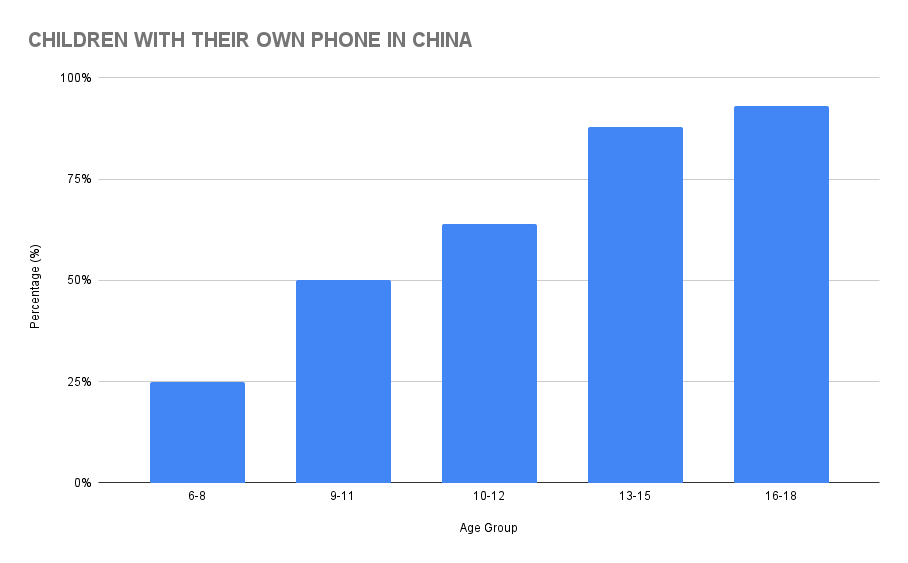
| CHILDREN WITH THEIR OWN PHONE IN CHINA (2025), BY AGE GROUP | |
|---|---|
| Age Group | % with own phone |
| 0-5 | Very low / uncommon |
| 6-8 | ~20-30% |
| 9-11 | ~40-60% |
| 10-12 | ~64% |
| 12-14 | ~70-85% |
| 13-15 | ~85-90% |
| 16-18 | ~90-95% |
| Minors overall | ~70% |
- In China 64% of children coming towards the end of primary school (those aged 10-12) own their own smartphone.
- Ownership then rises to 85-90% for 13-15 year olds and 90-95% for 16-18 years old.
- Overall, roughly 70% of minors own their own smartphone in China.
How Many Kids Have a Mobile Phone in India?
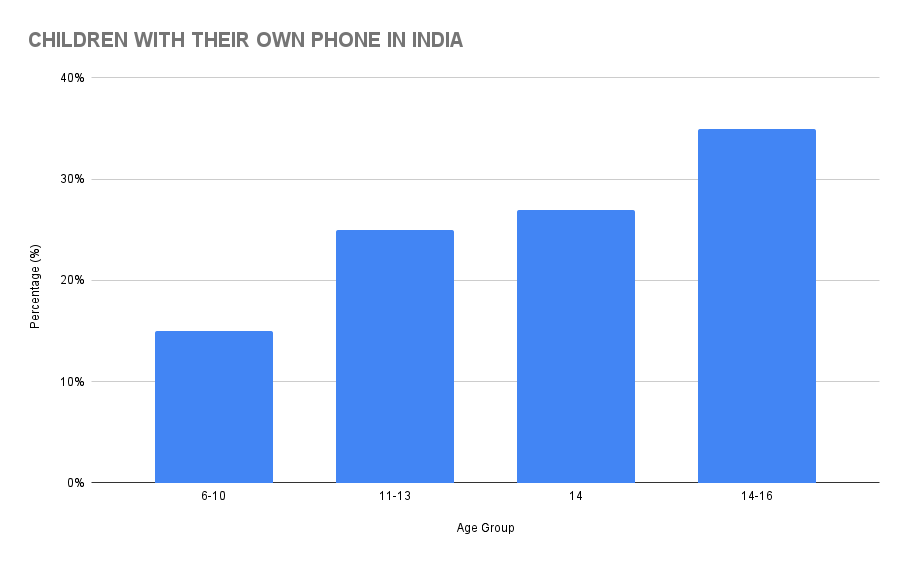
| CHILDREN WITH THEIR OWN PHONE IN INDIA (2025), BY AGE GROUP | |
|---|---|
| Age Group | % with own phone |
| 0-5 | Very low / uncommon |
| 6-10 | ~10-20% |
| 11-13 | ~20-30% |
| 14 | ~27% |
| 14-16 | ~30-38% |
| 14-18 | ~20–44% (large gender gap) |
| Household access (14–16) | ~90% have a smartphone at home |
- India has a much lower ownership percentage at an early age. A 2024 report indicated that just 27% of 14 year olds own their phone. This increases to 37.8% for 16 year olds. 13
- Even between the age of 14 and 18 ownership of a smartphones remains relatively low in India. However it is worth noting these children will almost certainly have access to parents smartphones even if they don’t own one themselves.
How Many Kids Have a Mobile Phone in Russia?
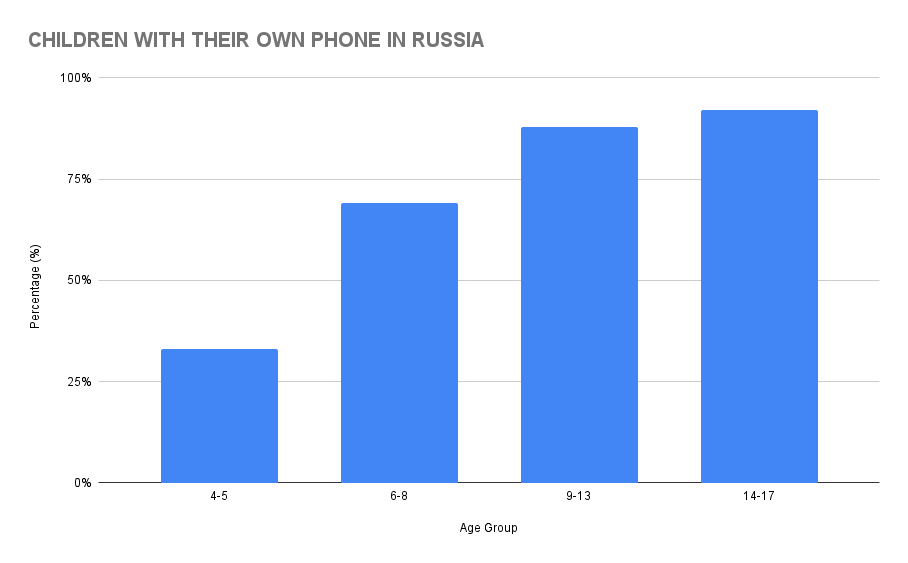
| CHILDREN WITH THEIR OWN PHONE IN RUSSIA (2025), BY AGE GROUP | |
|---|---|
| Age Group | % with own phone |
| 0-3 | Very low / uncommon |
| 4-5 | ~33% |
| 6-8 | ~69% |
| 7 and under | ~43% |
| 9-13 | ~88% |
| 8+ | ~82% |
| 14-17 | ~92% |
| School students overall | ~90%+ |
- In Russia roughly 1 in 3 (33%) pre-schoolers (those aged 4-5) have access to or use a smartphone.
- Ownership then rises significantly. At 6-8 years old, 69% of children own a smartphone.
- At 9-13 years old 88% of children own a smartphone. When children in Russia reach 14-17 years old that percentage rises to 92% which is almost everyone.
How Many Kids Have a Mobile Phone in Canada?
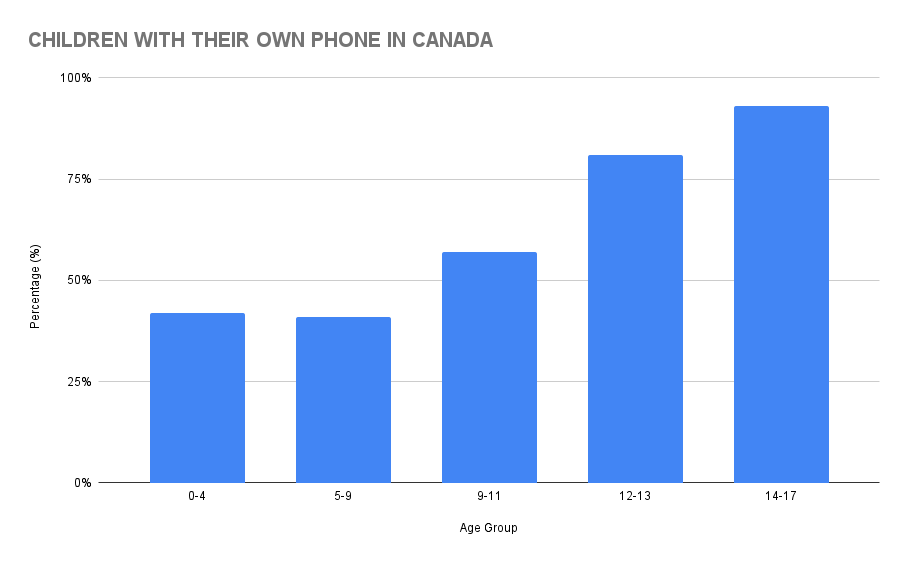
| CHILDREN WITH THEIR OWN PHONE IN CANADA (2025), BY AGE GROUP | |
|---|---|
| Age Group | % with own phone |
| 0-4 | ~40-42% |
| 5-9 | ~41% |
| 9-11 | ~57% |
| 10-13 | ~55% |
| 12-13 | ~81% |
| 14-15 | ~77% |
| 14-17 | ~93% |
| 12-17 overall | ~80-90% |
- Around 57% of children aged 9-11 own a smartphone in Canada.
- Ownership then rises to 81% for those aged 12-13 and 93% for those aged 14-17.
- A national family wellbeing survey in Canada found that an incredible 42% of children aged 0-4 have access to or use smartphones.
How Many Kids Have a Mobile Phone in Germany?
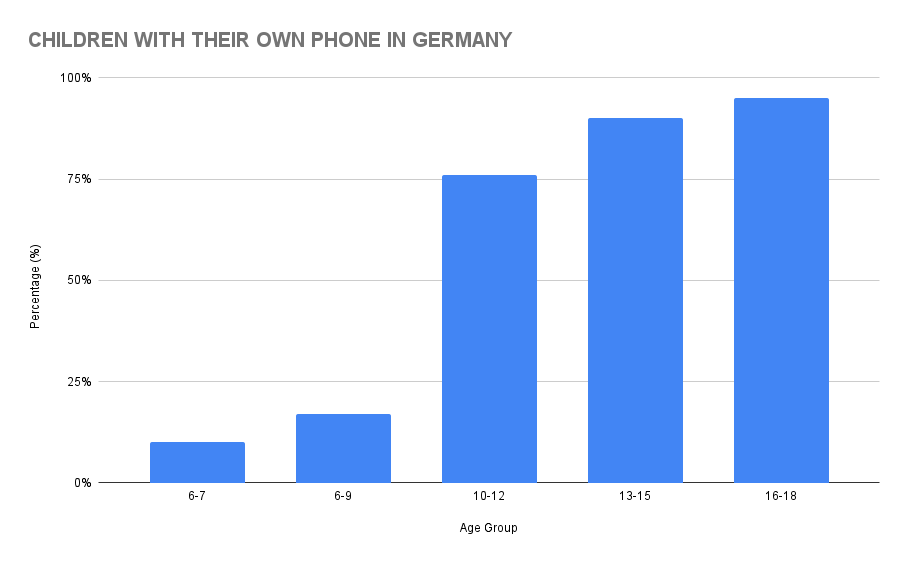
| CHILDREN WITH THEIR OWN PHONE IN GERMANY (2025), BY AGE GROUP | |
|---|---|
| Age Group | % with own phone |
| 0-5 | Very low / uncommon |
| 6-7 | ~9-11% |
| 6-9 | ~17% |
| 10-12 | ~75-76% |
| 12 | ~71% |
| 12-13 | ~79-81% |
| 13-15 | ~90% |
| 16-18 | ~95% |
| 6-18 overall | ~65% |
- In Germany only 17% of those aged 6-9 own a smartphone.
- Ownership then jumps to 76% in the 10-12 years of age bracket.
- About 90% of 13-15 year olds and 95% of those 16+ own a smartphone in Germany.
How Many Kids Have a Mobile Phone in France?
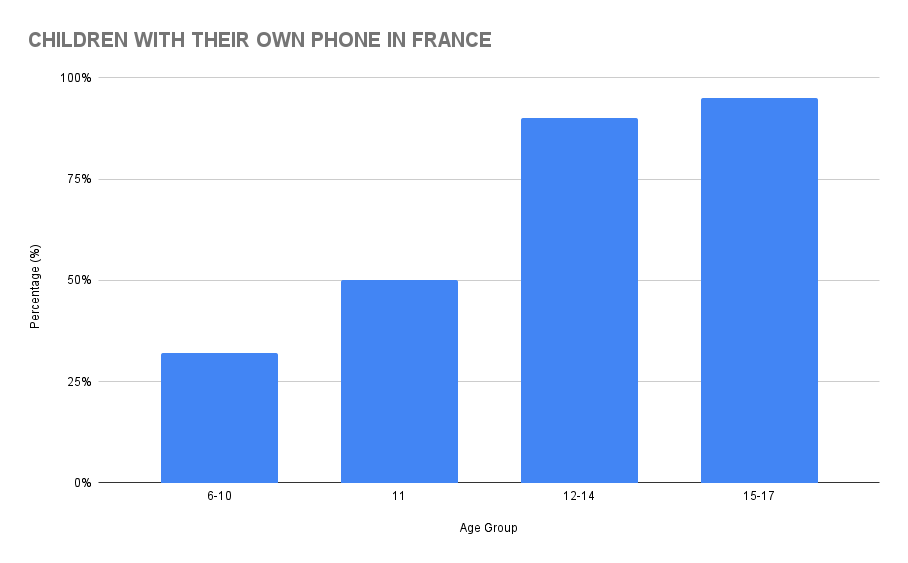
| CHILDREN WITH THEIR OWN PHONE IN FRANCE (2025), BY AGE GROUP | |
|---|---|
| Age Group | % with own phone |
| 3-5 | 10% |
| 6-10 | ~25-40% |
| 11 | ~50% |
| 12-14 | ~85-95% |
| 12-17 | ~90% |
| 15-17 | ~95% |
| 12+ | 98% |
- For younger children (under the age of 12) there is no national data for France, but we can estimate based on multiple surveys and policy reports.
- As with other countries ownership in France for those under the age of 10 is low and then spikes when children go to high school.
- At 12-14 years of age phone ownership could be as high as 95% which is near universal.
How Many Kids Have a Mobile Phone in Spain?
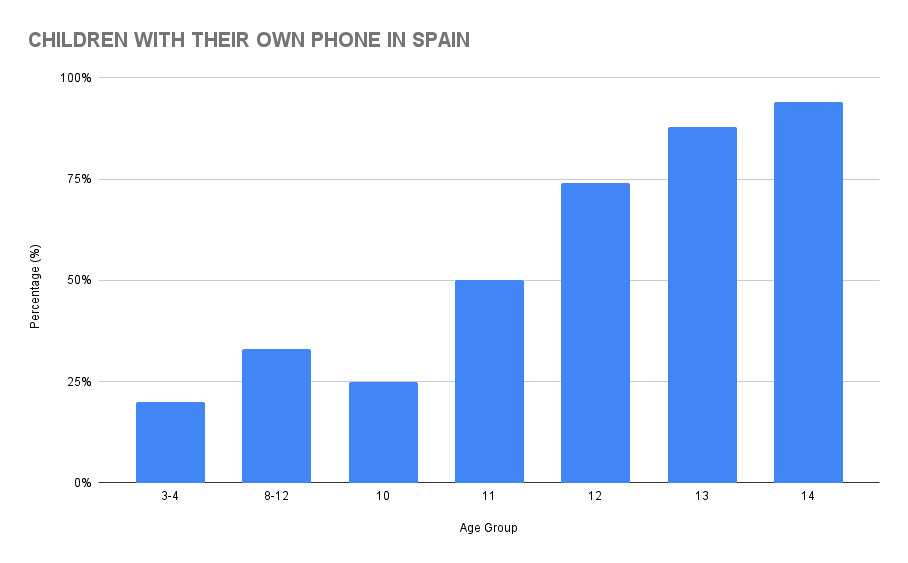
| CHILDREN WITH THEIR OWN PHONE IN SPAIN (2025), BY AGE GROUP | |
|---|---|
| Age Group | % with own phone |
| 3-4 | ~20% |
| 8-12 | ~33% |
| 10 | ~25% |
| 11 | ~50% |
| 12 | ~72-75% |
| 12-14 | ~85% |
| 13 | ~88% |
| 14 | ~94% |
| 10-15 overall | ~70% |
- In Spain around 1 in 5 toddlers (those aged 3-4) have access to or use a smartphone.
- In the 8-12 age group around 33% of kids in Spain own a smartphone.
- Once children go to high school you see a significant ownership surge. 72% ownership for those aged 12, 88% ownership for those aged 13 and 94% ownership for those aged 14.
How Many Kids Have a Mobile Phone in Brazil?
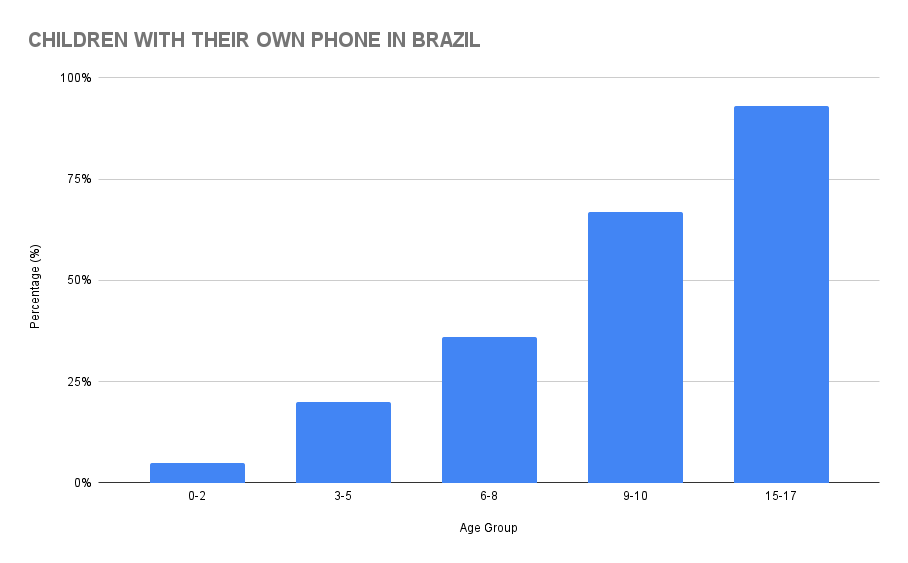
| CHILDREN WITH THEIR OWN PHONE IN BRAZIL (2025), BY AGE GROUP | |
|---|---|
| Age Group | % with own phone |
| 0-2 | ~5% |
| 3-5 | ~20% |
| 6-8 | ~36% |
| 9-10 | ~67% |
| 9-17 overall | ~81% |
| 15-17 | ~93% |
- In Brazil a minority of children under the age of 6 have access to or use a phone (less than 20%).
- During the primary school age groups we see a rapid increase in ownership. By 9-10 years of age, ownership is approximately 67%.
- Almost all teenagers in Brazil own a phone. For those in the 15-17 age bracket ownership is roughly 93%.
How Many Under-18s Have a Mobile Phone?
Data from UNICEF 5 indicated there are currently nearly 2.4 billion children under 18 years of age. Given how most data we’ve seen about mobile usage indicates that over 90% of kids have their own smartphone by the time they turn 18, we can say that about 2.16 billion kids have their own device.
What Percentage of Kids Have a Cell Phone?
While the numbers vary from country to country, we’ve noticed that about 50% of kids have their own cell phone by the time they become teenagers. The percentage of kids who own a phone grows rapidly and over 90% of them have one by the time they turn 18.
At What Age Should a Kid Get a Phone
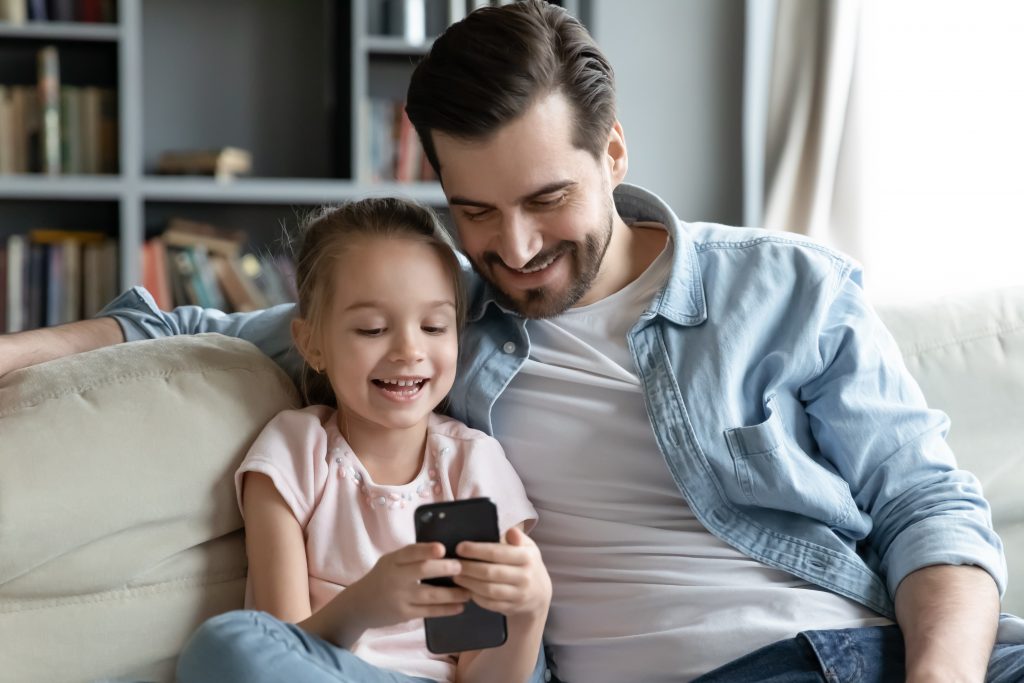
The debate over the ideal age for getting a phone has been ongoing for years. This is a subject that parents and guardians have to grapple with sooner or later. With the rapid advancement of technology, mobile phones have become ubiquitous. However, knowing the appropriate age at which children should be given smartphones is crucial to safeguard their well-being.
The consensus among child development experts is that children should ideally be ten to twelve years or older before they are given a personal mobile phone. 6 Before that age, parents can provide their children with simpler and more basic devices for communication, such as feature phones or GPS tracking devices. These devices provide a means for parents to remain in touch with their children. They can also locate them in case of emergencies, but without the added risks smartphones offer.
Children below thirteen are not mature enough to handle the implications of social media, messaging platforms, and “always-on” connectedness. Social media has been linked to negative self-image, anxiety, and depression. Moreover, when children are glued to their mobile screens, it can become challenging to control their use, which can lead to poor mental health, poor academic performance, and constant distraction.
Is Your Kid Ready for a Mobile Phone?
Beyond the problem of age, however, the more important bit is whether or not the child is ready for a smartphone. Dr. Jerry Bubrick, a clinical psychologist at the Child Mind Institute, says it’s more about the kid’s social awareness and understanding of technology than age. 7 Issues like if the child often loses things, how they handle money, how they pick up on social cues, and how savvy they are about technology, should be considered.
Parents should ensure that they provide adequate guidance on what apps should be installed and what content their children can access when giving them phones. If younger children need (rather than want) a phone due to how far their school is and for easier location tracking, which cannot be achieved with the help of a dumb phone, then parental supervision is required, points out child psychologist Kate Ehleman. 8 Several parental control apps can keep track of a child’s phone use, monitor their messages, limit app downloads, and blocking inappropriate content.
The Dangers of Kids and Mobile Phones
Before a child is given a smartphone, clear boundaries need to set, from screen time limitations to activity hours. Later on, when social media sites are introduced, extra monitoring is advised due to the risks that come with it. 9 From cyberbullying and online predators to the risk of oversharing personal information, having access to dangerous viral trends, damaged self-esteem, increased anxiety and irritability, social media comes with its own long list of dangers.
Studies even show that there are distinct developmental windows of sensibility to social media in adolescence. These windows occur at 14-15 and 19 years old for males and 11-13 and 19 for females. In short, social media use at these ages can lead to decreases in life satisfaction later on. 10
Ultimately, parents decide for their children based on their unique situation. Extra precaution is advised, however, alongside strong boundaries regarding screen time. Hopefully, as they grow, children learn to have a healthy relationship with their smartphones, the internet, and social media.
- YouGov.co.uk
- Marketing Charts based on Common Sense Media
- The Times
- Childwise via The Guardian
- UNICEF
- Washington Post
- Child Mind Institute
- Cleveland Clinic
- Child Mind Institute
- “Windows of developmental sensitivity to social media” by Amy Orben, Andrew K. Przybylski, Sarah-Jayne Blakemore & Rogier A. Kievit
- Pew Research Center
- The Guardian
- India Today
- Pew Research Center – Teens, Social Media and Technology 2023 (United States)
- Common Sense Media – 0–8 year olds (United States)
- Ofcom – Children and Parents 2024 (United Kingdom)
- Ofcom – Children and Parents 2025 (United Kingdom)
- CNNIC – Statistical Report on Internet Development (China)
- News summaries / youth surveys (China)
- ASER / news reports on teen mobile ownership (India)
- NewIndianExpress (India)
- Mediascope – Kids gadget usage (Russia)
- Telecompaper – >80% of kids over 7 own smartphones (Russia)
- Mediasmarts – Digital Canadian Families (Canada)
- White Hatter – Smartphone usage (Canada)
- Bitkom / KIM Studie 2024 (Germany)
- Postbank Digital Study – Smartphones in primary school (Germany)
- ARCEP – Digital device ownership and usage (France)
- INSEE – National statistics (France)
- Fortune – News reports citing surveys (Spain)
- SURinEnglish (Spain)
- CETIC.br – Children up to 8 years old (Brazil)
- IBGE – Mobile phone penetration (Brazil)
Our content is created in good faith and reviewed regularly - if you spot an error, please contact corrections@sellcell.com. Read our Editorial Policy


