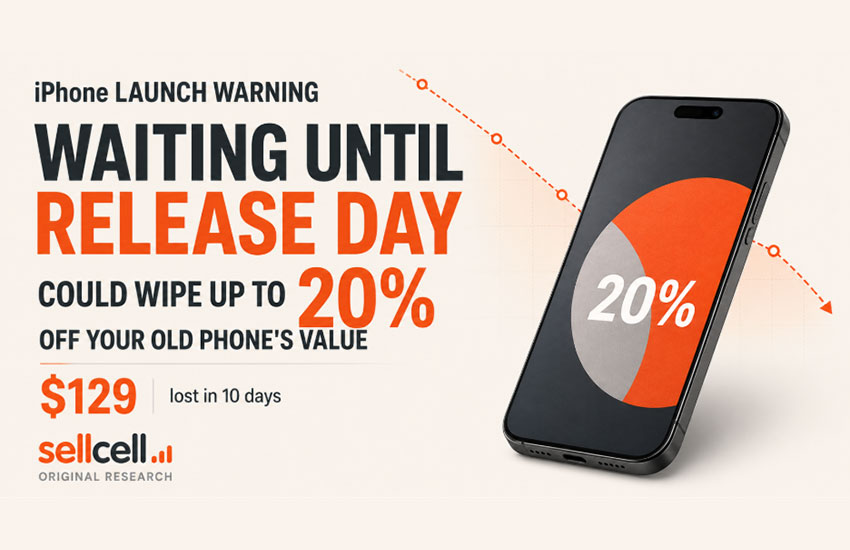

61% surveyed wait until their replacement arrives before selling their old device—risking up to $129 in lost trade-in value.
Key Findings
- 61.4% of iPhone users would wait until receiving and setting up their new phone before trading in the old one.
- 77.4% would delay because they need their old iPhone for continued use or to transfer their data.
- Across the past three Apple launches, 117 of 156 iPhones tracked—75%—lost trade-in value between announcement and release day.
- During the latest launch, 50 of 54 iPhones—92.6%—lost value in 10 days; the largest cash loss was $129, while one iPhone lost 20.2% of its trade-in value.
- 82.8% did not know some independent buyers offer price locks, but 66.1% said one would make them more likely to arrange their trade-in earlier.
Introduction
Apple’s next iPhone launch is approaching, and existing owners face a familiar problem: when should they trade in their old phone?
Selling early may secure a stronger price. However, most owners still need their old iPhone while waiting for the replacement to arrive. They may also need it to transfer photographs, messages, apps and other personal data.
New SellCell research shows how much this delay could cost.
SellCell surveyed 2,000 iPhone users and compared their intended trade-in behaviour with historical pricing from the iPhone 15, iPhone 16 and iPhone 17 launches.
The results reveal a clear trade-in trap. More than three in five users would wait until receiving and setting up their new phone. However, across the past three launches, three in four iPhones tracked lost value between Apple’s announcement and release day.
During the latest launch, one model lost $129 in only 10 days.
Main Findings
- 61.4% of iPhone users would wait until receiving and setting up their new phone before trading in the old one.
- 77.4% would delay selling or trading in because they need their existing iPhone for continued use or to transfer data.
- Across the iPhone 15, iPhone 16 and iPhone 17 launches, 117 of 156 iPhones tracked—75%—lost trade-in value between Apple’s announcement and release day.
- Ahead of the iPhone 17 release, 50 of 54 iPhones—92.6%—lost value in 10 days, with an average loss of $36.46.
- The iPhone 16 Plus 512GB recorded the largest cash loss, falling by $129 between announcement and release.
- The iPhone 15 Plus 128GB recorded the largest percentage fall, losing 20.2% of its trade-in value—from $440 to $351—in 10 days.
- 82.8% did not know some independent buyers offer price locks, which hold a phone’s value for an agreed period while it remains in use.
- 66.1% said a price lock would encourage them to arrange their trade-in earlier.
SellCell Research: The iPhone Trade-In Waiting Trap
Part One: SellCell Survey of 2,000 iPhone Users
To understand how iPhone owners approach an Apple launch, SellCell asked 2,000 US iPhone users four questions: when they would sell or trade in their existing device, why they might wait, whether they knew about trade-in price locks, and whether a price lock would make them act earlier. The charts below show the results.
Q1. When Do iPhone Owners Sell or Trade In Their Old Phone Around an Apple Launch?
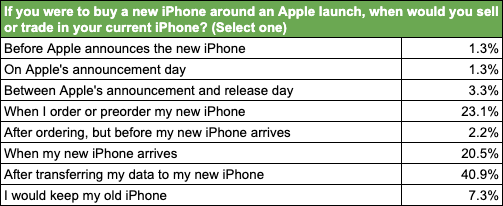
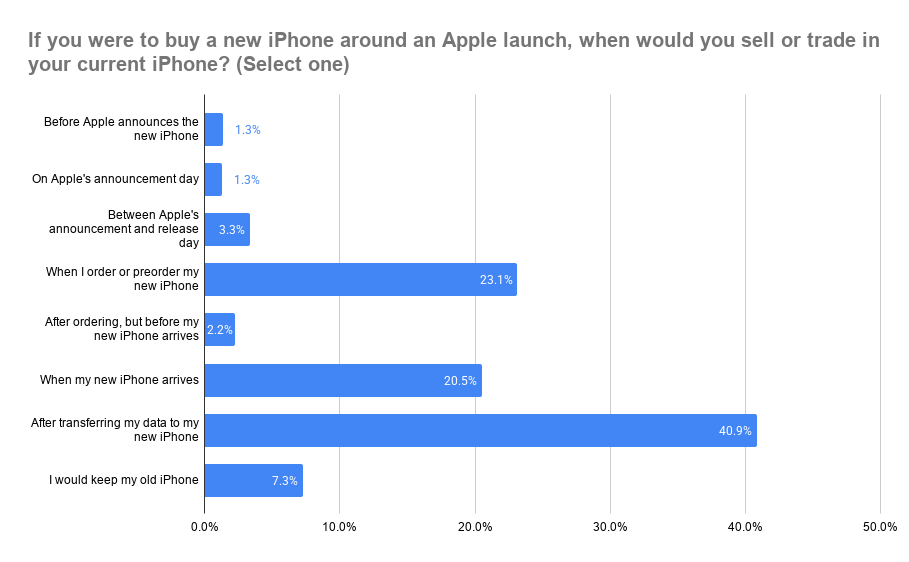
- 40.9% would wait until after transferring their data to their new iPhone.
- 20.5% would trade in their old phone when the replacement arrives.
- Combined, 61.4% would keep their old phone until receiving and setting up its replacement.
- 23.1% would arrange the trade-in when ordering or preordering their new iPhone.
- 2.2% would act after ordering but before the new phone arrives.
- 5.9% would trade in before Apple’s announcement, on announcement day or between announcement and release.
- 7.3% would keep their old iPhone.
For most owners, the arrival of the replacement—not Apple’s announcement—is the point at which they feel ready to part with their old phone. Unfortunately, that means waiting through a period when trade-in prices can fall quickly.
Q2. Why Do iPhone Owners Delay Selling or Trading In Their Old Phone?
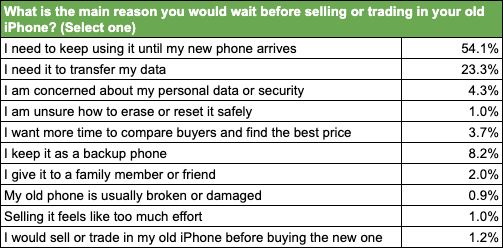
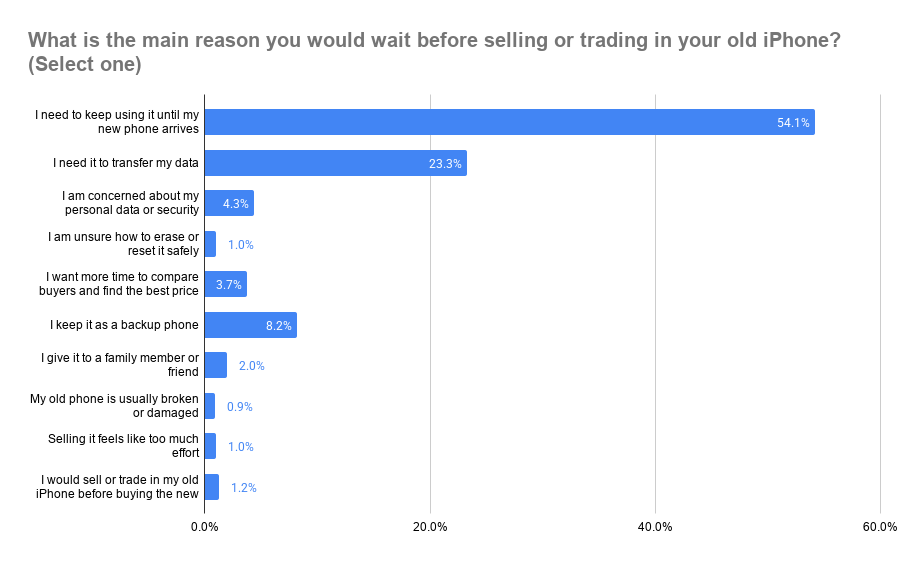
- 54.1% need to continue using their old iPhone until the new one arrives.
- 23.3% need it to transfer their data.
- Combined, these practical reasons account for 77.4% of responses.
- 8.2% would keep the old phone as a backup.
- 4.3% are concerned about their personal data or security.
- 3.7% want more time to compare buyers and find the best price.
- 2.0% would give it to a family member or friend.
- 1.0% are unsure how to erase or reset it safely.
- 1.0% feel selling it is too much effort.
- 0.9% said their old phone is usually broken or damaged.
- 1.2% would sell or trade in their old iPhone before buying the new one.
The overwhelming majority are waiting because they still need the device—not because they are unconcerned about price.
Q3. How Many iPhone Owners Know About Trade-In Price Locks?

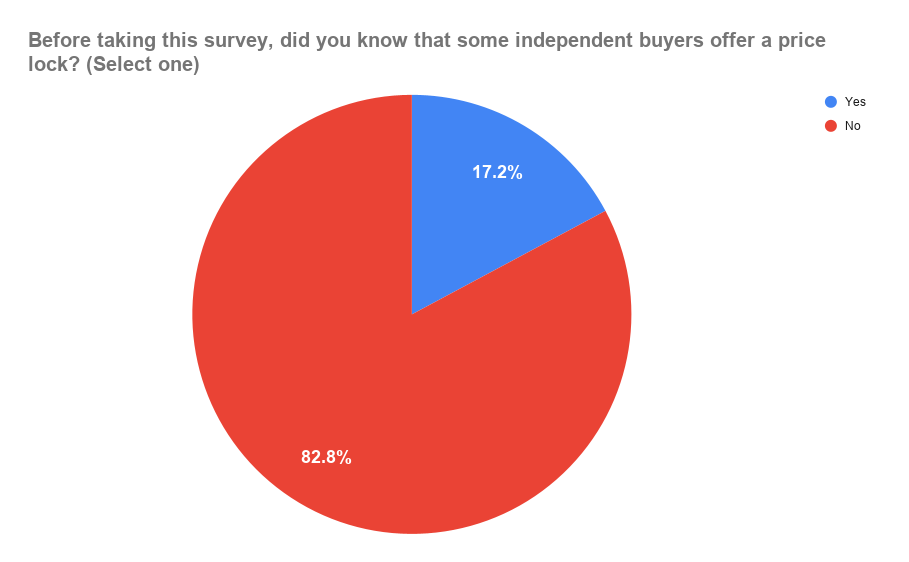
- 82.8% did not know that some independent buyers offer a price lock.
- 17.2% were already aware of the option.
A price lock holds the value of a phone for an agreed number of days while the owner continues using it. Where available, it may allow someone to secure a valuation before sending the phone to the buyer.
Q4. Would a Price Lock Encourage Earlier Trade-Ins?

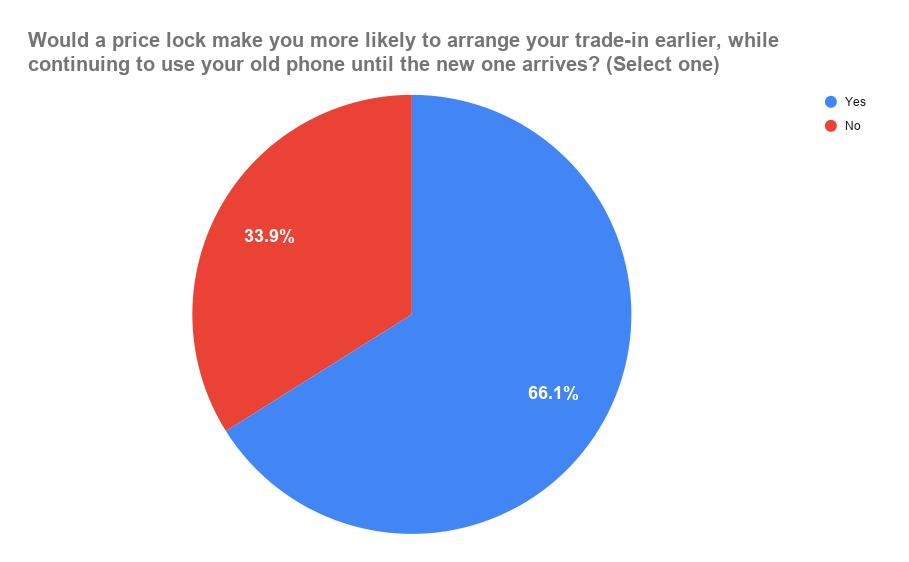
- 66.1% said a price lock would make them more likely to arrange their trade-in earlier.
- 33.9% said it would not change their behaviour.
This directly addresses the main reason owners delay: they do not want to be left without a phone.
Part Two: What Waiting Can Cost — SellCell’s Historic Price Analysis
To understand what this delay can mean in real money, SellCell analysed historic trade-in prices around the iPhone 15, iPhone 16 and iPhone 17 launches.
For every model and storage capacity tracked, we compared the highest available trade-in price on Apple’s announcement day with the highest available price on release day—typically just 10 or 11 days later.
Table 1: Trade-In Value Lost Between Apple’s Announcement and Release Day
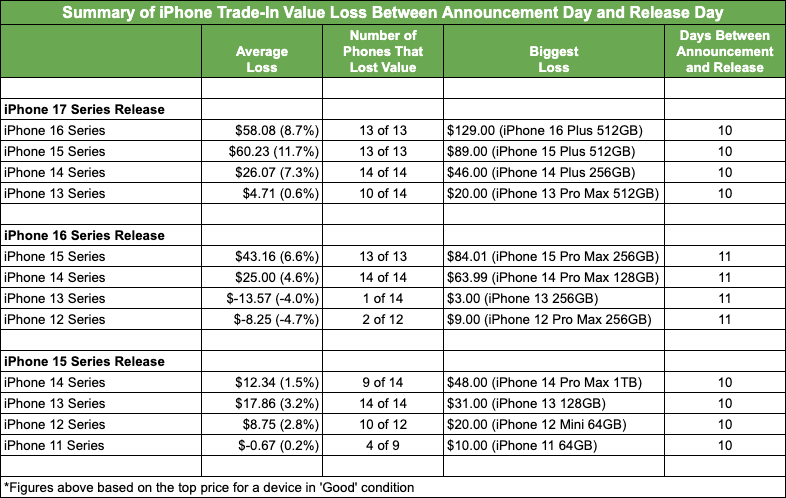
Across the iPhone 15, iPhone 16 and iPhone 17 launches, 117 of 156 iPhones tracked lost trade-in value between Apple’s announcement and release day.
That means exactly 75%—or three in four—were worth less by release day.
The table shows that the most recent launch was particularly severe. Ahead of the iPhone 17 release, 50 of 54 iPhones tracked lost value in 10 days. The average loss across all models was $36.46.
The largest cash loss was $129, while the biggest percentage fall reached 20.2%.
Table 2: The Biggest Percentage Trade-In Value Losses Between Announcement and Release
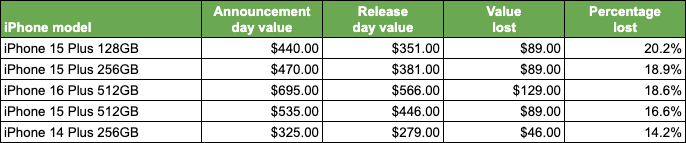
All five of the biggest percentage losses occurred during the 10 days between the iPhone 17 announcement and release.
The iPhone 15 Plus 128GB recorded the largest proportional fall, dropping from $440 to $351—a loss of $89, or 20.2% of its trade-in value.
The iPhone 16 Plus 512GB recorded the largest cash loss, falling from $695 to $566—a loss of $129, or 18.6%.
This does not mean every iPhone will lose value in exactly the same way. However, the historic data shows that the short period between Apple’s announcement and release can be a particularly risky time to delay arranging a trade-in.
Conclusion
More than three in five iPhone users would wait until receiving and setting up their new phone before trading in their old one.
For most, the reason is entirely practical. They need the existing phone for everyday use or to transfer their personal data.
However, that wait can come at a cost.
Across the past three Apple launches, three in four iPhones tracked lost trade-in value between announcement and release day.
During the latest launch, 93% lost value in only 10 days. The average loss was $36.46, while the worst-hit model lost $129.
Consumers considering an upgrade should compare trade-in prices as soon as Apple announces its new iPhone rather than automatically waiting for release day
Where an appropriate price lock is available, it may offer a way to protect the phone’s value without immediately giving up the device when selling your iPhone.
Methodology
SellCell surveyed 2,000 US iPhone users in August 2026.
Respondents answered four closed questions covering:
- When they would sell or trade in their existing iPhone around an Apple launch.
- Their main reason for waiting.
- Their awareness of independent buyer price locks.
- Whether a price lock would encourage them to arrange their trade-in earlier.
Survey responses reflect stated intentions rather than verified purchasing or trade-in behaviour.
SellCell also analysed historical trade-in pricing from its network of independent buyers around the iPhone 15, iPhone 16 and iPhone 17 launches.
The announcement-to-release analysis compares the top available trade-in price for each model and storage capacity on Apple’s announcement day with its top price on release day.
All pricing figures are based on the top available trade-in price for a device in “Good” condition. Individual offers may vary according to the buyer, device condition and terms of the trade-in.
Our content is created in good faith and reviewed regularly - if you spot an error, please contact corrections@sellcell.com. Read our Editorial Policy


