
Foldable phone owners lose almost $1,000 on average within 12 months, according to new SellCell research.
Menu: Jump to a section
- Key Findings
- Introduction
- Main Findings
- Foldables vs Traditional Smartphones
- Which Brands Hold Their Value Best?
- The Worst Smartphone Investments
- The Phones Consumers Lose The Most Money On
- The Most Expensive Phones Don't Hold Their Value Best
- The Best Smartphone Investments
- Does Storage Capacity Affect Resale Value?
- What This Means for Apple
- What Could a $2,000 Foldable iPhone Be Worth After One Year?
- Conclusion
- Methodology
Key Findings
- Foldable smartphone owners lose an average of $997.69 after 12 months, compared with $605.32 for traditional smartphone owners.
- Foldables lose 64.6% of their value within a year, making them the worst-performing smartphone category for value retention.
- Apple’s iPhone 16 lineup retained the most value after 12 months, keeping 51.5% of its launch price on average.
- The Samsung Galaxy Z Fold6 1TB recorded the largest loss in the study, shedding $1,479.99 in value within a year.
- A hypothetical $2,000 foldable iPhone could lose as much as $1,292 in its first year if it follows current foldable depreciation trends.
Introduction
Apple is widely rumoured to be preparing its first foldable iPhone, with several analysts and industry reports suggesting the device could launch in 2026 at a price of around $2,000.
While foldables have become some of the most expensive devices on the market, their resale performance has received far less attention than their hardware innovation.
Industry sources including Reuters, Ming-Chi Kuo and Jeff Pu have all pointed towards a potential 2026 launch window, with several reports suggesting Apple’s first foldable device could debut alongside the iPhone 18 family. While Apple has not officially confirmed the product, expectations are growing that the company is preparing to enter the foldable smartphone market for the first time.
To find out whether consumers are getting value for that premium, SellCell analysed the resale performance of flagship smartphones 12 months after launch, comparing foldables and traditional smartphones across Apple, Samsung, Google, Motorola and OnePlus.
The study compares foldable and traditional flagship smartphones 12 months after launch, analysing value retention, depreciation rates and ownership costs across Apple, Samsung, Google, Motorola and OnePlus devices. It identifies the best and worst smartphone investments, the devices generating the largest monetary losses, and what a potential $2,000 foldable iPhone could be worth after one year based on current market trends.
“Foldable smartphone owners lose almost $1,000 on average within 12 months — nearly $400 more than consumers who purchase traditional flagship devices.”
Main Findings
- Foldable smartphones lose an average of 64.6% of their value within 12 months.
- Traditional smartphones lose an average of 55.3% of their value within 12 months.
- Foldable smartphone owners lose an average of $997.69 after one year.
- Traditional smartphone owners lose an average of $605.32 after one year.
- Foldable owners lose $392.37 more on average than traditional smartphone owners.
- Foldables retain 35.4% of their launch value after 12 months.
- Traditional smartphones retain 44.7% of their launch value after 12 months.
- Apple’s iPhone 16 lineup retained 51.5% of its value after 12 months.
- Motorola devices retained 24.5% of their launch value on average.
- The Samsung Galaxy Z Fold6 1TB lost $1,479.99 in value within 12 months.
- Five of the six largest monetary losses recorded in the study came from foldable devices.
- Nine of the ten best-performing devices for value retention were iPhones.
- The most expensive smartphones analysed were overwhelmingly foldable devices.
- Many of the most expensive devices also appeared among the biggest monetary losers.
- A hypothetical $2,000 foldable iPhone could lose as much as $1,292 in its first year if it follows current foldable depreciation trends.
Foldables vs Traditional Smartphones
Key Findings
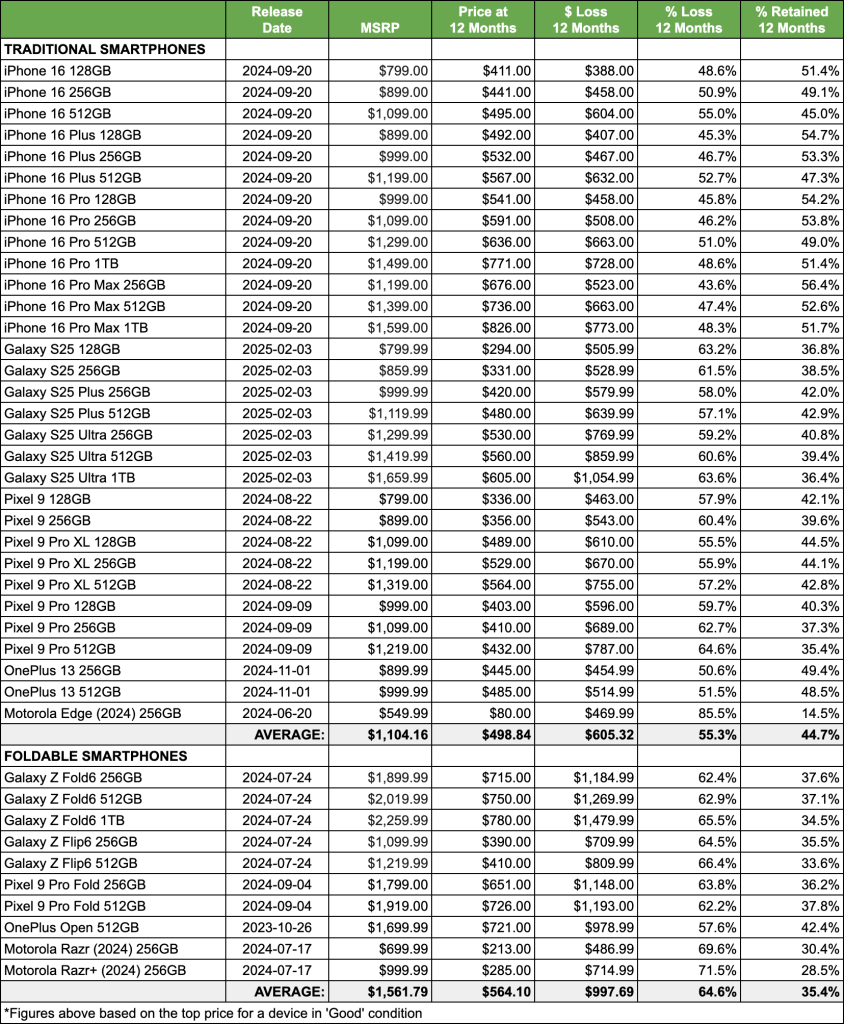
- Foldables lost an average of 64.6% of their value after 12 months.
- Traditional smartphones lost 55.3%.
- Foldable owners lost $997.69 on average.
- Traditional smartphone owners lost $605.32.
- Consumers lost $392.37 more by choosing a foldable smartphone.
- Foldables retained just 35.4% of their launch value compared to 44.7% for traditional smartphones.
Foldable smartphone owners lost an average of $997.69 after 12 months, compared with $605.32 for traditional smartphone owners. Foldables also retained just 35.4% of their launch value, compared with 44.7% for traditional smartphones.
Which Brands Hold Their Value Best?
Key Findings
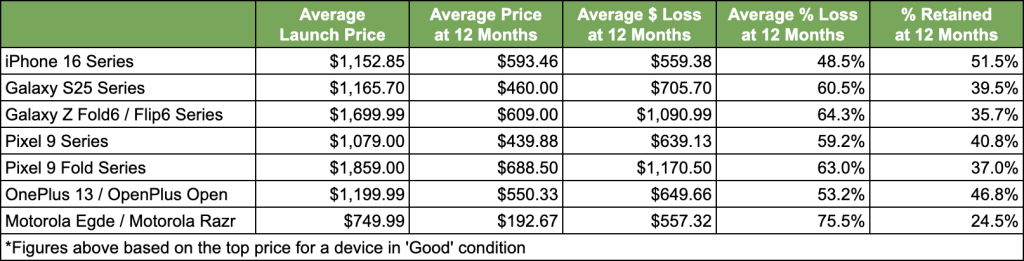
- Apple retained 51.5% of value after 12 months.
- OnePlus retained 46.8%.
- Google retained 40.8% with the Pixel 9 series and 37.0% with the Pixel 9 Fold series.
- Samsung retained 39.5% with the Galaxy S25 series and 35.7% with the Galaxy Z Fold6 / Flip 6 series.
- Motorola retained just 24.5%.
Apple achieved the strongest value retention of any major manufacturer analysed.
The Worst Smartphone Investments
Key Findings
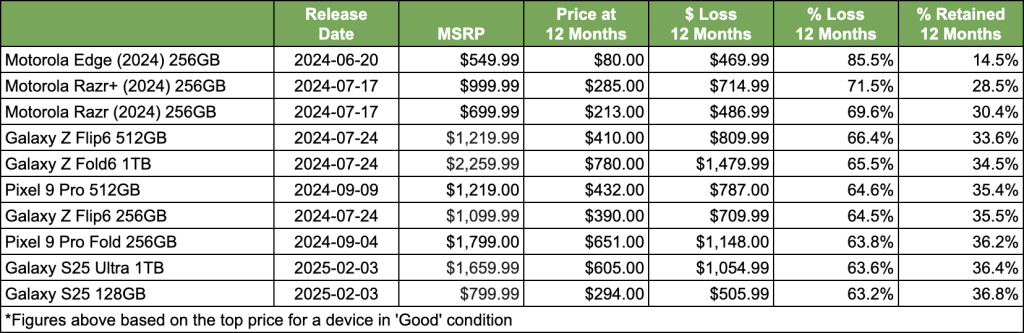
- Motorola Edge (2024) lost 85.5% of its value.
- Motorola Razr+ (2024) lost 71.5%.
- Motorola Razr (2024) lost 69.6%.
- Samsung Galaxy Z Flip6 512GB lost 66.4%.
- Samsung Galaxy Z Fold6 1TB lost 65.5%.
Four of the five worst-performing devices in the study were foldables, while the Motorola Edge (2024) recorded the highest overall depreciation at 85.5%.
The Phones Consumers Lose the Most Money On
Key Findings
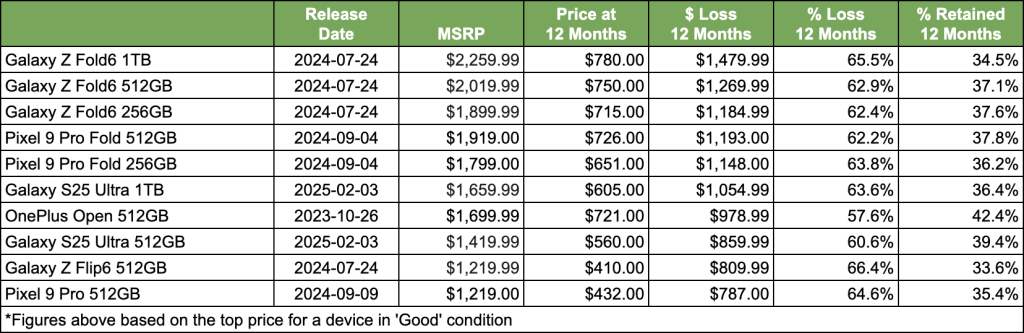
- Samsung Galaxy Z Fold6 1TB lost $1,479.99.
- Samsung Galaxy Z Fold6 512GB lost $1,269.99.
- Google Pixel 9 Pro Fold 512GB lost $1,193.00.
- Samsung Galaxy Z Fold6 256GB lost $1,184.99.
- Google Pixel 9 Pro Fold 256GB lost $1,148.00.
Five of the six largest monetary losses recorded in the study came from foldable devices. The Samsung Galaxy Z Fold6 1TB recorded the largest loss overall at $1,479.99.
The Most Expensive Phones Don’t Hold Their Value Best
Key Findings
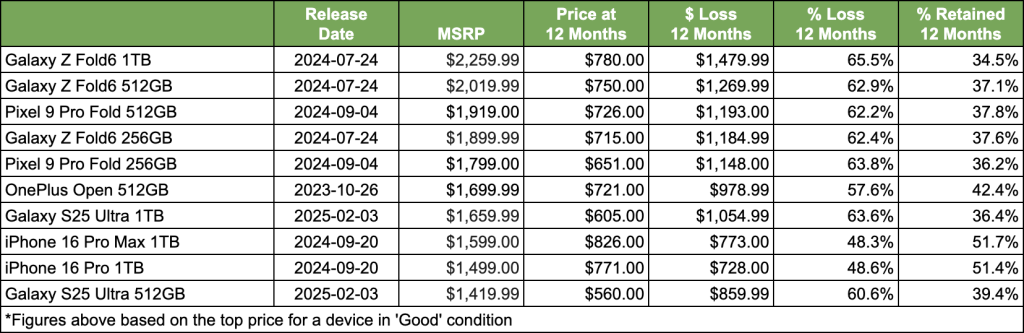
- Foldables dominated the list of the most expensive smartphones analysed.
- Two devices launched with price tags exceeding $2,000.
- Many of the most expensive devices also appeared among the biggest monetary losers.
- The Samsung Galaxy Z Fold6 1TB combined one of the highest launch prices with the largest loss in the study.
Two devices launched above $2,000, and both ranked among the largest monetary losers in the study.
The Best Smartphone Investments
Key Findings
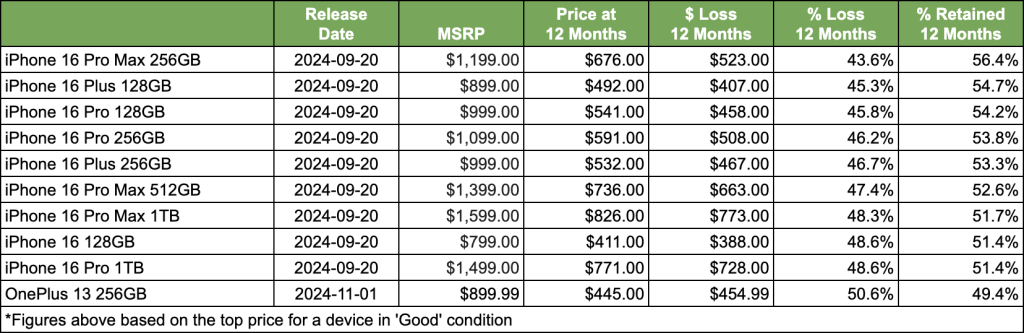
- Nine of the ten best-performing devices were iPhones.
- The iPhone 16 Pro Max ranked among the strongest performers.
- The iPhone 16 Plus and iPhone 16 Pro models also featured prominently.
- Apple dominated the top of the rankings.
Nine of the ten best-performing devices for value retention were iPhones, with the iPhone 16 Pro Max, iPhone 16 Plus and iPhone 16 Pro all ranking among the strongest performers.
Does Storage Capacity Affect Resale Value?
Key Findings
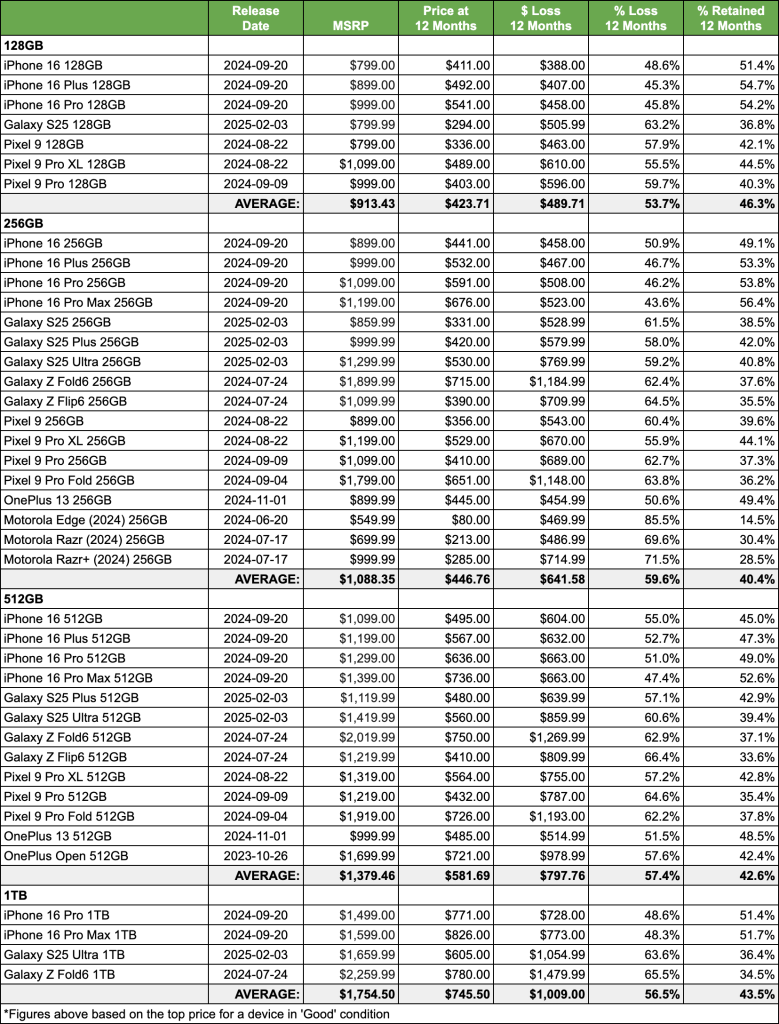
- Higher-capacity devices often generated larger monetary losses.
- Premium storage upgrades did not consistently retain value better than lower-capacity models.
Higher-capacity devices often generated larger monetary losses, but did not consistently retain value better than lower-capacity versions.
What This Means for Apple
The foldable market presents a very different challenge for Apple.
While Apple’s iPhone 16 lineup retained 51.5% of its value after one year, foldables as a category retained just 35.4%.
The category also generated the largest ownership losses in the study, with consumers losing almost $1,000 on average after 12 months.
As Apple prepares to enter the foldable market, one of its biggest challenges may not be hardware innovation but convincing consumers and the second-hand market that foldables deserve to hold their value.
If Apple can bring traditional iPhone-level value retention to a foldable device, it could help address one of the category’s biggest weaknesses.
What Could a $2,000 Foldable iPhone Be Worth After One Year?
Key Findings
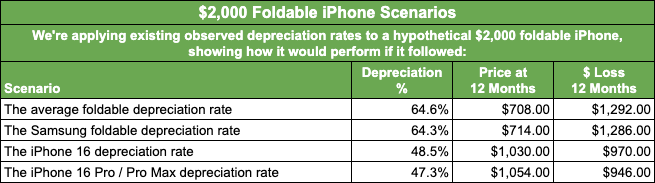
- If a $2,000 foldable iPhone depreciated at the average rate of today’s foldables, it would be worth approximately $708 after 12 months.
- Under that scenario, owners would lose around $1,292 in value during the first year.
- If Apple achieved depreciation rates similar to the iPhone 16 range, the device could be worth around $1,030 after 12 months.
- That would equate to more than $300 less depreciation than a typical foldable smartphone.
While Apple has not confirmed pricing, several analyst reports have suggested a foldable iPhone could launch at around $2,000. To understand what that could mean for consumers, SellCell modelled how a hypothetical $2,000 foldable iPhone might perform after 12 months based on current smartphone resale trends.
If a foldable iPhone followed the depreciation patterns of today’s foldables, owners could lose around $1,292 within a year. However, if Apple achieved value retention similar to the iPhone 16 lineup, first-year depreciation could be more than $300 lower. That difference could become a key selling point in a category where ownership costs remain one of the biggest barriers to adoption.
Conclusion
Foldable smartphone owners lose almost $1,000 on average after 12 months, according to SellCell’s analysis of first-year smartphone depreciation.
While Apple emerged as the strongest-performing major brand, the most significant finding was the performance gap between foldables and traditional smartphones.
Consumers currently lose almost $1,000 on average when purchasing a foldable device, nearly $400 more than traditional smartphone owners.
With Apple expected to launch its first foldable iPhone in the near future, the company is about to enter a category that has so far struggled to retain value. The challenge for Apple won’t simply be building a great foldable phone — it will be proving that foldables can hold their value in a way that existing devices have failed to achieve.
Whether Apple can bring traditional iPhone-level value retention to a foldable device may ultimately determine whether foldables become a mainstream category or remain a niche premium product.
Methodology
SellCell analysed flagship smartphones launched within the last two years where a complete 12 months of resale data was available.
The study included devices from Apple, Samsung, Google, Motorola and OnePlus.
All devices were assessed using Good-condition resale values.
Launch MSRP was compared against median resale values exactly 12 months after release.
Percentage value lost, percentage value retained and monetary loss were then calculated for each device and category to identify the best and worst smartphone investments.
Our content is created in good faith and reviewed regularly - if you spot an error, please contact corrections@sellcell.com. Read our Editorial Policy


