
Adoption has reached 78%, but confidence hasn’t followed, with 72% of iPhone users still reporting at least one concern when updating
Key Highlights
- 78% of iPhone users say they’ve updated to iOS 26
- 22% have not yet upgraded to iOS 26
- 72% report at least one concern or hesitation about updating to iOS 26
- Only 39% update immediately when prompted, while 61% delay, dismiss, or passively handle updates
- Battery life (24.2%) and performance (23.8%) are the most common hesitation factors
- 17.5% dislike the Liquid Glass design or readability
Introduction
Apple’s iOS 26 is one of the most noticeable iPhone updates in recent years, introducing a range of system changes alongside Liquid Glass, a new visual design that changes how iOS looks and feels.
At the same time, recent security-focused coverage has encouraged users to move away from older iOS versions, as protections and legacy pathways are phased out if models can support iOS 26. As a result, many iPhone users are facing increasing pressure to update, even if they remain unsure about the impact on battery life, performance, or usability.
Reporting around iOS 26 upgrade rates has been inconsistent, with some sources suggesting relatively low adoption and others pointing to much higher uptake. This has made it harder to gauge not just how widely the update has been installed, but how confidently users have approached it.
This report examines how iPhone users are actually responding to iOS 26. Using survey data from 2,000 iPhone users, SellCell analyses adoption levels, update behaviour, and the specific concerns creating hesitation around Apple’s latest operating system.
For many users, updating to iOS 26 isn’t an easy yes or no — it’s something they think about, weigh up, and often delay. So, let’s look at what the data shows.
Main Findings
The findings show a clear gap between how many users have installed iOS 26 and how confident they feel about doing so.
- 78% of iPhone users report having updated to iOS 26, while 22% say they have not yet upgraded, despite the update being available for several months.
- Only 28% of respondents say nothing they’ve seen puts them off updating, meaning 72% report at least one concern or hesitation around the update.
- Most users do not update immediately when prompted, with 61% delaying, dismissing, or passively handling updates.
- Battery life and performance remain the most common hesitation drivers, even among many users who have already updated.
- Reaction to Apple’s Liquid Glass redesign is mixed, with 17.5% of users disliking the design or readability and a further 8.6% frustrated that it can’t be fully turned off.
- 15.0% are concerned about the difficulty of reverting once iOS 26 is installed.
- 11.4% worry about bugs or features breaking.
- Overall, most users install iOS 26 cautiously rather than confidently, with hesitation shaping both timing and experience.
Chart Analysis
Chart 1: iOS 26 Adoption Status
(Question 1 – Pie chart: Updated vs Not Updated)
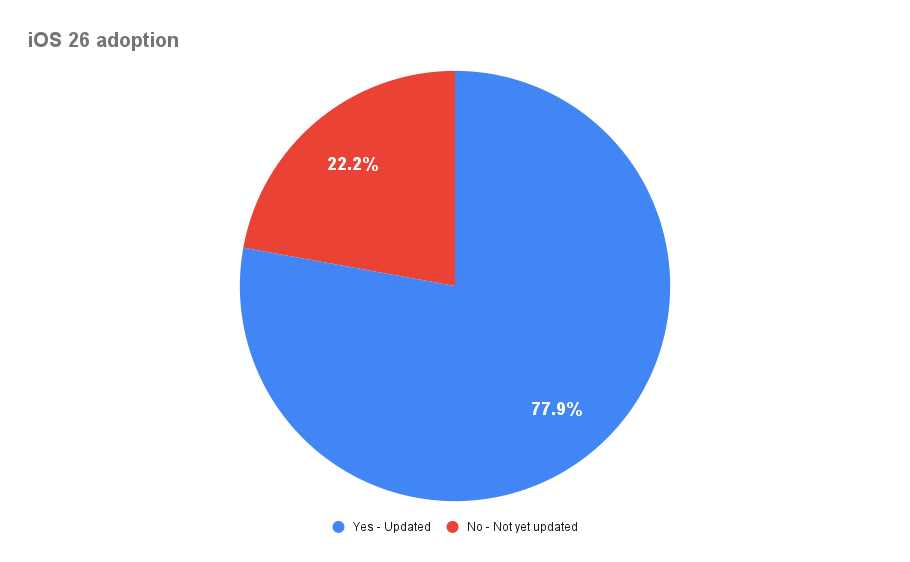
- 78% of respondents report having updated to iOS 26 and 22% have not yet upgraded
- The 22% figure underpins the “one in five” headline referenced in this report
- While adoption is widespread, a sizeable minority remain on older versions
Chart 2: Why Some iPhone Users Have Not Upgraded to iOS 26
(Question 1 follow-up – Reasons given by non-upgraders only)
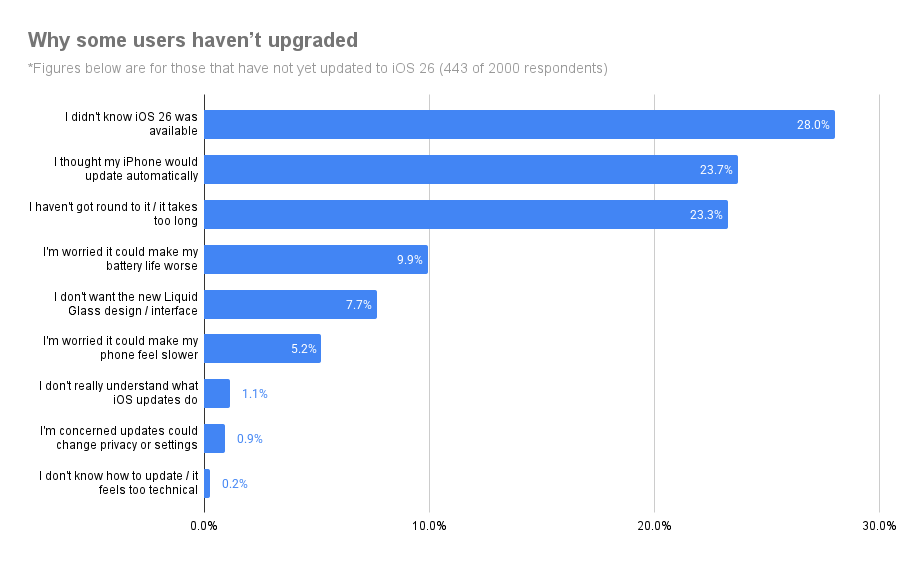
Among the 22% of iPhone users who have not yet upgraded to iOS 26 (443 respondents)
- Awareness and inertia account for the largest share of responses, with 28.0% of those who did not upgrade stating they were unaware iOS 26 was available, 23.7% assuming automatic updates, and 23.3% saying they haven’t got round to it
- Battery-related concerns are present but secondary, with 9.9% of the 443 worried updating could worsen battery life
- Design resistance plays a smaller but meaningful role, with 7.7% of the non-upgraders not wanting the Liquid Glass interface
- Performance concerns are cited by 5.2% of non-upgraders
- Very small proportions cite understanding or confidence barriers
- Percentages shown relate only to non-upgraders and not the full user base
Chart 3: How Users Respond to iOS 26 Update Prompts
(Question 2 – Update behaviour)
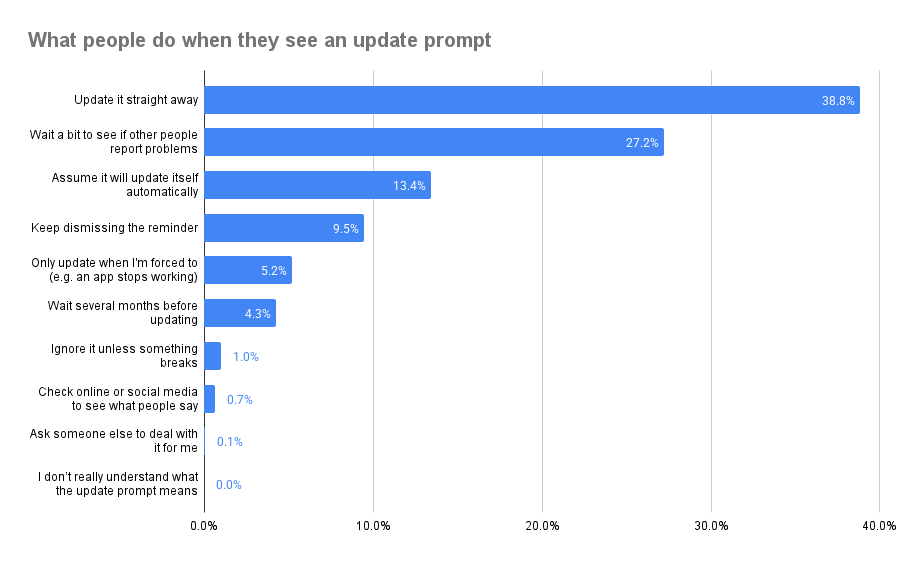
Looking across all 2,000 surveyed iPhone users:
- 38.8% update immediately when prompted
- 27.2% wait to see if other users report problems
- 13.4% assume updates happen automatically
- 9.5% dismiss update reminders
- 5.2% only update when an app stops working
- 4.3% wait several months before updating
- Very small proportions seek external reassurance or help
- Overall, users are more likely to delay or defer updates than act immediately
Chart 4: Reasons for Hesitation Around iOS 26
(Question 3 – Multi-select concerns across all users)
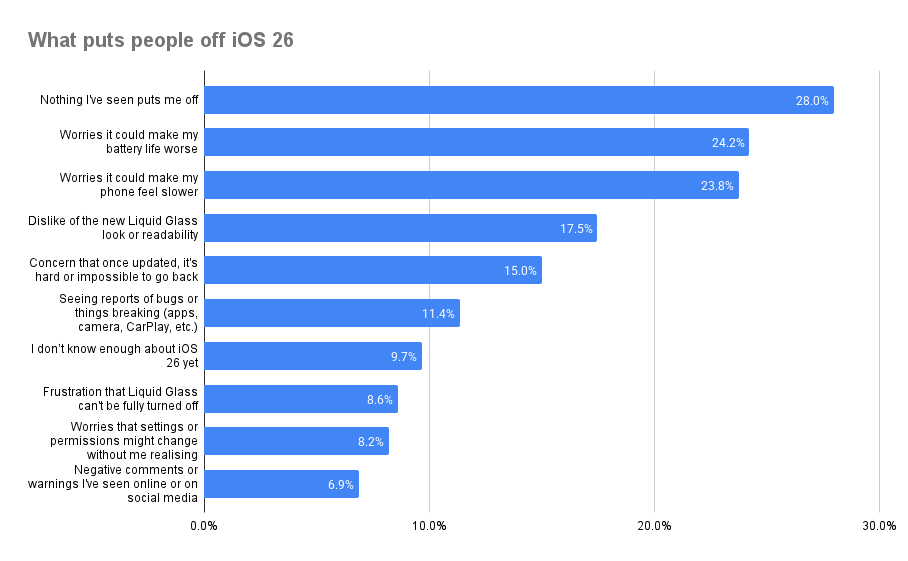
Across the full sample of 2,000 iPhone users
- 28.0% say nothing they’ve seen puts them off updating
- This means 72.0% report at least one concern or hesitation about iOS 26
- Battery life and performance dominate hesitation, cited by 24.2% and 23.8% respectively
- Design resistance is significant, with 17.5% disliking Liquid Glass and 8.6% frustrated it can’t be fully turned off
- 15.0% worry it may be hard or impossible to revert once updated
- 11.4% cite reports of bugs or features breaking
- Knowledge gaps and settings concerns also contribute to hesitation
Percentages overlap as respondents could select multiple concerns
Conclusion
Overall, iOS 26 has seen strong uptake, but confidence hasn’t kept pace. One in five iPhone users still haven’t upgraded, and even among those who have, many continue to flag concerns around battery life, performance, design changes, and how easy it would be to roll back if something goes wrong. For many users, it comes down to how the update will affect their phone in day-to-day use.
Methodology
SellCell surveyed 2,000 U.S.-based adult iPhone users in January 2026. Participants answered three closed questions covering update status, update behaviour, and hesitation factors. One question allowed multiple responses.
Results reflect self-reported attitudes and behaviour rather than device-verified adoption. No personally identifiable information was collected as part of the process.
Our content is created in good faith and reviewed regularly - if you spot an error, please contact corrections@sellcell.com. Read our Editorial Policy


